

When one room in your Lapeer-area home is always too warm, another stays chilly, or your HVAC system seems louder than usual, the problem may not be the thermostat or the furnace itself. The return-air system could be struggling.
Return vents are easy to overlook because they do not blow warm or cool air into the room. However, they play a central role in how your heating and cooling system circulates air. Blocked, undersized, dirty, or poorly connected returns can reduce comfort, increase energy use, and place unnecessary strain on your equipment.
At Michigan Heating, Cooling & Plumbing, our 3rd-generation, family-owned team takes a no-BS approach: we look for the actual airflow problem before recommending a major repair or replacement. Sometimes the right solution is a return-air correction or Ductwork repair: not a new HVAC system.
Return Vents Bring Air Back
A forced-air HVAC system needs a continuous air path. Supply vents deliver conditioned air into your rooms. Return vents pull room air back to the furnace or air handler, where it can be filtered, heated, cooled, and circulated again.
Think of your HVAC system as a loop:
- Conditioned air leaves through supply vents.
- Air moves through the rooms.
- Room air returns through return grilles.
- The furnace or air handler conditions the air again.
Supply vents and return vents have different jobs, but both must have enough open space to work correctly. If the return side is restricted, the blower may not be able to move the proper amount of air through the system: even if the furnace or air conditioner is operating normally.
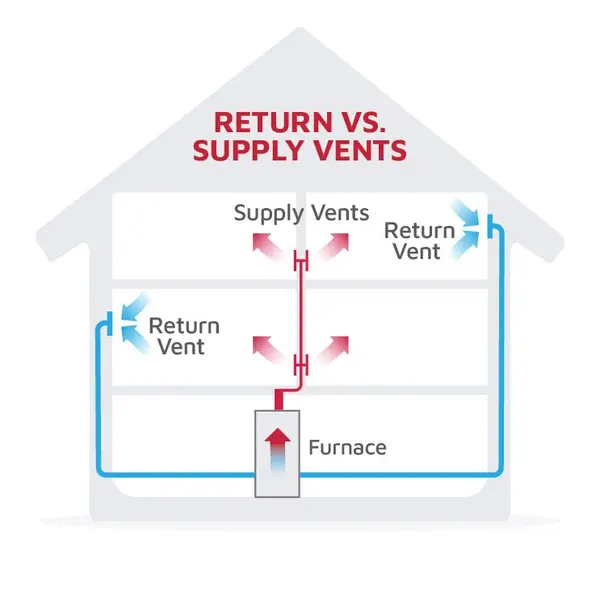
Supply Vents Push. Returns Pull.
Supply registers are usually smaller and located throughout the home. You may find them on floors, walls, or ceilings. They push heated or cooled air into individual rooms.
Return grilles are often larger. They may be located on a wall, in a hallway, or near the central part of the home. Their job is to pull air back toward the equipment.
A return grille should not be covered by a couch, bed, storage bin, rug, curtain, or decorative object. Even partial blockage can increase resistance and reduce the amount of air reaching the furnace or air handler.
This can create a pressure imbalance throughout the home. Rooms with closed doors may have an especially difficult time receiving or returning air if they do not have a dedicated return grille, transfer grille, or another properly designed airflow path.
Watch for These Return-Air Warning Signs
Return-air problems often develop gradually. You may notice the symptoms before you see the cause.
Rooms That Stay Uncomfortable
If one bedroom is consistently colder in winter or warmer in summer, restricted return airflow may be part of the problem. The thermostat measures conditions in one location, but it cannot correct poor circulation in rooms that are not receiving or returning enough air.
Whistling or Rattling Grilles
A return grille that whistles, hisses, rattles, or makes a strong whooshing sound may be dealing with excessive air velocity or a restriction. Loose grille hardware can cause rattling, but persistent noise should not be ignored.
A Noisy or Strained Blower
A blower that sounds louder than normal may be working against high resistance. A dirty filter, blocked return, undersized grille, or damaged return duct can all contribute to increased system pressure.
Weak Supply-Airflow
If the air coming from supply vents feels weaker than it used to, the issue may be on the return side. The blower needs a balanced path for air to leave and come back. Improving supply vents alone will not solve a restricted return.
Excessive Dust
Leaking or poorly connected return Ductwork can pull dusty, unconditioned air from a basement, crawlspace, attic, or wall cavity. A restrictive filter or inadequate circulation can also allow dust and odors to remain in living spaces longer.
Doors That Are Hard to Close
Pressure imbalances can cause interior doors to slam, resist closing, or move when the HVAC system starts. This does not automatically confirm a return-air problem, but it is a useful clue: especially in rooms with closed doors and no dedicated return.
Short Cycling or Long Runtime
A furnace that starts and stops too frequently may be responding to overheating, airflow restriction, thermostat conditions, or another equipment problem. An air conditioner with inadequate airflow may run for long periods, struggle to cool the home, or develop a frozen coil.
Better return airflow supports both heating and cooling. However, it cannot fix an undersized furnace, failing blower motor, damaged heat exchanger, refrigerant problem, or aging air conditioner by itself. Proper diagnosis matters.
Common Causes of Poor Return Airflow
Several everyday conditions can restrict the return side of an HVAC system:
- Furniture placed directly in front of a return grille
- Rugs or carpeting covering floor-level returns
- Curtains hanging over wall returns
- Closed or undersized return grilles
- Decorative grille covers with too little open area
- Dirty filters loaded with dust and pet hair
- Crushed, kinked, disconnected, or leaking return ductwork
- Poorly designed duct layouts
- Closed bedroom doors without an adequate return-air path
- Home additions or remodeling that changed room sizes and airflow
- New walls, flooring, or furniture that cover an existing return
- Zone dampers or duct components that are not operating correctly
Home renovations can create return-air problems without anyone realizing it. A room addition may add more conditioned space without adding enough return capacity. A new built-in cabinet may partially cover a grille. Even replacing flooring can reduce the opening around a floor return.

Safe Checks You Can Do
Before scheduling service, you can safely look for simple restrictions.
Clear the Area
Move furniture, boxes, baskets, rugs, and other items away from return grilles. Make sure curtains do not hang over the opening. Keep the full grille face unobstructed.
Check the Filter
Locate the filter behind a return grille or near the furnace and inspect it according to the manufacturer’s instructions. Replace a visibly dirty or loaded filter with the correct size and type.
A filter should protect your equipment and support indoor air quality, but an overly restrictive or incorrectly sized filter can reduce airflow. If you are unsure which filter your system requires, ask for professional guidance.
Listen During a Heating or Cooling Cycle
Stand near each return while the system is running. A mild, steady sound is normal. Loud whistling, rattling, or an unusually strong pull may indicate a restriction.
Check Interior Doors
Notice whether certain rooms become uncomfortable when their doors are closed. This may point to an inadequate return path. Do not permanently prop doors open if that is inconvenient; instead, have the airflow design evaluated.
Compare Supply Airflow
With the system running, feel the airflow at several supply vents. A major difference between rooms, especially after clearing returns and replacing the filter, may indicate a ductwork or balancing problem.
Do Not Remove Filters or Close Supply Vents
When airflow feels weak, some homeowners remove the filter or close supply vents in rooms they do not use. These steps can make the problem worse.
Running without a filter allows dust and debris to enter the blower, coil, and internal equipment. That buildup can reduce performance and lead to expensive repairs.
Closing multiple supply vents does not create more usable airflow. It can increase pressure in the duct system and make the equipment work under less favorable conditions. A better solution is to identify why the system is not moving the right amount of air.
When to Call for Professional Testing
If basic checks do not resolve the issue, professional diagnostics can identify problems that are hidden behind walls, ceilings, and equipment panels.
Our team may evaluate:
- Airflow at supply and return locations
- Static pressure across the HVAC system
- Filter pressure drop
- Return-duct sizing and condition
- Disconnected, leaking, crushed, or poorly sealed Ductwork
- Blower performance
- Furnace and air-conditioner compatibility
- Room pressure and return-air pathways
- Changes caused by remodeling or additions
Static-pressure testing is especially helpful because it measures how hard the blower is working to move air. Visual inspection alone cannot always identify an undersized return, excessive restriction, or design imbalance.
Depending on the findings, the practical repair may involve sealing a duct connection, replacing a damaged section, improving a grille, adding a transfer path, correcting a filter cabinet, or modifying the return layout. Better return airflow can help your existing equipment operate more reliably, but we will also explain when the system itself is undersized, failing, or no longer appropriate for the home.
Protect Comfort Without Unnecessary Replacement
Furnace Maintenance and AC maintenance can help identify airflow concerns before they contribute to larger equipment problems. Regular service also gives us an opportunity to inspect filters, blower operation, coils, and accessible duct connections.
If you need furnace repair services, an airflow diagnosis should be part of the conversation when symptoms point to the return side. Replacing a furnace without correcting a restricted return may leave the same comfort problem in place.
That is where our family-owned approach matters. We have a big appetite for serving more local homes and businesses, but we remain grounded in straightforward recommendations. We repair when practical, explain your options clearly, and do not push equipment replacement when a return-air or ductwork correction is the better answer.
Return-Air Checklist
Use this quick checklist if your HVAC system is noisy, uneven, or less efficient than usual:
- Are all return grilles fully visible?
- Is furniture at least several inches away from each grille?
- Are rugs, curtains, and storage items clear of the openings?
- Is the HVAC filter clean and the correct size?
- Do you hear whistling, rattling, or hissing?
- Is the blower louder than it used to be?
- Are some rooms uncomfortable when doors are closed?
- Are interior doors difficult to close when the system runs?
- Has a recent remodeling project changed a room or covered a grille?
- Are you experiencing weak airflow, long runtimes, or short cycling?
If you checked several boxes, schedule an evaluation before the issue leads to higher energy costs or unnecessary equipment strain.
For help with return-air problems, Ductwork, energy efficient hvac systems, Furnace Maintenance, AC maintenance, or furnace repair services, make an appointment with Michigan Heating, Cooling & Plumbing. You can also request an online estimate, review current coupons and savings, or ask about flexible payment plans through GoodLeap financing.
A return-air problem may be simple, hidden, or connected to a larger system issue. Either way, getting the airflow diagnosed is the first step toward a more comfortable and energy-conscious home.

Michigan Heating, Cooling & Plumbing
Website: www.michiganheating.com
Facebook: https://www.facebook.com/michiganheatandcool
Instagram: https://www.instagram.com/michigan_heating_cooling/